- 1.0 Executive Summary
- 2.0 Understanding Apple's Strategic Objectives
- 3.0 The PlaceOS Solution: An Integration & Automation Platform
- 4.0 Interfaces
- 5.0 Transforming the Apple Retail Environment
- 6.0 Data-Driven Insights for Operational Excellence
- 7.0 Proposed Path Forward: A Phased Partnership
- 8.0 Investment and Commercial Models
Executive Summary
This proposal outlines a strategic partnership to implement the PlaceOS platform across Apple's global retail portfolio, beginning with a single-store Proof of Concept (POC). The core challenge of system fragmentation, as identified during discussions with Apple Australia's facilities leadership, will be addressed by deploying a unified software layer that integrates Apple's existing, high-quality investments in Extron, Crestron, Lutron, and Automated Logic (ALC) systems. PlaceOS is designed to transform Apple's retail stores from a collection of siloed building systems into a single, intelligent, and responsive ecosystem. This initiative will not only drive significant operational efficiencies and advance sustainability goals but, more importantly, will ensure the physical in-store environment consistently reflects the seamless, integrated experience synonymous with the Apple brand.
The PlaceOS platform functions as a vendor-agnostic integration and automation engine, sitting above existing hardware to unlock new capabilities without requiring costly and disruptive rip-and-replace projects. The primary value of this solution extends beyond technical consolidation; it is about preserving and enhancing the brand. The current operational friction caused by disparate systems creates a subtle but meaningful disconnect between the flawlessly integrated world of Apple products and the physical environment in which they are experienced. By unifying the store's "operating system," PlaceOS aligns the physical space with the core brand promise.
The key outcomes of this partnership will be threefold. First, it will provide Unified Control and Monitoring, offering a single pane of glass for all building systems. This delivers unprecedented visibility and control for local store management, regional leadership in APAC, and global operations teams. Second, the platform will deliver an Enhanced Customer and Employee Experience. Sophisticated, automated workflows will create a more comfortable, responsive, and engaging environment, from automated store opening sequences to dynamic environmental adjustments for "Today at Apple" sessions. Finally, the solution will enable Data-Driven Operational Excellence. Actionable insights derived from newly integrated data streams will empower proactive facilities management through a direct link to Service Channel, optimize energy consumption to meet corporate objectives, and inform the design of future retail spaces.
This proposal details a fixed-scope, production-ready POC at a single flagship retail store. The objective of this initial phase is to demonstrate the platform's full capabilities in a live environment and to establish a robust, scalable template for an efficient regional and subsequent global rollout.
I look forward to discussing PlaceOS and Apple Retail in more detail.
-- Jon McFarlane (jon@place.technology), CEO PlaceOS
Understanding Apple's Strategic Objectives
A thorough understanding of Apple's current operational landscape is the foundation of this proposal. The retail environment currently operates on a collection of best-in-class but functionally siloed systems. This includes Extron for audiovisual (AV) control, Crestron or Lutron for lighting systems, and an ongoing transition from Building Maintenance, Inc. (BMI) to Automated Logic (ALC) for heating, ventilation, and air conditioning (HVAC). This technological fragmentation inherently creates operational inefficiencies and, critically, prevents the holistic data integration required for advanced management, automation, and analytics.
The impact of this fragmentation extends beyond the facilities team. It introduces friction into the daily operations of the store and can subtly detract from the meticulously curated, effortless customer journey that is paramount to the Apple brand. For instance, preparing a store for a high-profile "Today at Apple" event may require manual adjustments to multiple, separate control interfaces for lighting, AV, and climate. A security event captured by one system is not automatically correlated with data from another, such as linking a door access event to a specific video feed, a capability that a unified platform enables. This lack of cohesion impacts operational agility, consumes valuable staff time, and represents a missed opportunity to make the physical environment as intelligent and responsive as the products it showcases.
The strategic opportunity, as identified by Apple's facilities leadership, is to introduce a unifying software layer that abstracts the complexity of the underlying hardware. This layer will establish a consistent operational standard and user experience across all stores, regardless of the specific legacy systems installed at each location. It provides a future-proof platform for innovation, embodying the PlaceOS core principle of allowing organizations to "switch systems without breaking workflows". This approach not only solves today's challenges but also ensures that Apple's retail infrastructure can seamlessly adapt to future technological advancements. The following table provides a clear visual contrast between the current fragmented state and the proposed unified solution.
| Function | Current State (Fragmented Control) | Proposed State (Unified Platform) |
|---|---|---|
| Audiovisual (AV) Control | Extron Web Control Interface | PlaceOS Unified Interface (Web, Mobile, Automation) |
| Lighting Control | Crestron or Lutron Panels/Software | PlaceOS Unified Interface (Web, Mobile, Automation) |
| HVAC Management | ALC / BMI Native Interfaces | PlaceOS Unified Interface (Web, Mobile, Automation) |
| Security Systems | Disparate, Vendor-Specific Panels | PlaceOS Unified Interface (Event Correlation, Monitoring) |
| Facilities Management | Service Channel Web Portal | PlaceOS Platform with Automated Service Channel Integration |
| Data & Analytics | Siloed, Inaccessible System Data | Centralized Time-Series Database with Unified Dashboards |
The PlaceOS Solution: An Integration & Automation Platform
The PlaceOS platform is architected to serve as the central nervous system for the modern built environment. It is not a replacement for Apple's existing high-performance systems from Extron, Crestron, or ALC; rather, it is a powerful software platform that sits above them, unlocking their collective potential and enabling them to work in concert.
3.1 Core Platform Architecture
Vendor-Agnostic Integration Layer
The foundation of PlaceOS is its extensive library of integration drivers. These drivers are purpose-built software modules that communicate with third-party systems in their native protocols, whether via modern REST APIs, industry-standard building protocols like BACnet/IP and MQTT, or other communication methods. This approach protects Apple's significant investments in its existing hardware infrastructure while simultaneously modernizing its control and automation capabilities. A key architectural principle of the platform is the decoupling of automation logic from the underlying hardware. This means that complex workflows—such as a store's morning startup sequence—are built once within PlaceOS. If, in the future, Apple decides to switch from one lighting vendor to another in a new store or during a renovation, only the underlying driver module is changed. The entire automation sequence, user interfaces, and data reporting remain intact, providing unparalleled flexibility and future-proofing the investment.
Global Scalability and Centralized Management
The PlaceOS platform is explicitly designed for global scale, a capability proven in deployments for enterprise clients such as McKenzie, with 190 offices, and Nestle, with 30 offices managed from a single instance. For University customers we manage all their teaching spaces- up to 700 rooms and thousands of AV and building system end-points. A single, centrally-hosted PlaceOS deployment can serve all of Apple's retail locations worldwide. This centralized architecture is a powerful tool for regional and global leadership. It provides the APAC and global operations teams with a unified dashboard and control plane, enabling them to monitor performance, enforce brand standards, and deploy updates across the entire portfolio from one location, ensuring a consistent experience for customers and staff everywhere.
Data Sovereignty and Security
PlaceOS recognizes the paramount importance of data privacy and security for Apple. To meet these stringent requirements, the platform offers flexible deployment models. The entire PlaceOS stack can be deployed on Apple's private cloud infrastructure, giving Apple's IT and security teams full architectural control, oversight, and the ability to manage and revoke access permissions for the PlaceOS support team as needed. This ensures that all operational data remains within Apple's security perimeter. With this model, Apple owns the system, and more importantly, Apple owns the data.
3.2 Unifying Building and Operational Systems
The platform's strength lies in its proven ability to integrate with the specific systems currently operating within Apple Retail.
Building Management Systems (BMS)
PlaceOS will integrate seamlessly with Apple's new ALC HVAC systems. These systems are built on open standards, and the integration will be achieved using the industry-standard BACnet/IP protocol, for which ALC provides robust support. This connectivity will provide granular, real-time control over temperature setpoints, operating modes (e.g., Occupied/Unoccupied), and fan speeds. This control can then be driven by intelligent automation based on store schedules, real-time occupancy levels, and indoor environmental quality (IEQ) data.
Lighting Control
The platform includes mature, field-tested drivers for both Lutron and Crestron lighting systems. This will allow for the centralized command of lighting scenes (e.g., "Welcome," "Presentation," "Energy Save," "Closed") and the fine-tuning of individual fixture levels. This capability moves lighting control from a manual, wall-panel-driven task to a dynamic element of the store's automated operations.
Audiovisual (AV) Control
PlaceOS will be able to automate the powering on and off of displays, video walls, and audio systems, as well as the routing of specific sources for events. This ensures that all AV equipment is reliably ready for "Today at Apple" sessions and is efficiently powered down afterward to conserve energy and extend equipment lifespan. We can link AV Control to workflow automation- such as scheduled events and real-time capacity. And all AV systems can be managed remotely including viewing current state- and controlling end-points manually or with user interfaces.
Facilities Management Software (Service Channel)
A critical component of this solution is the integration with Service Channel, a key requirement for Apple's facilities leadership. Service Channel's platform provides comprehensive, cloud-based APIs for managing work orders, assets, and service providers. The integration of PlaceOS with Service Channel represents a strategic bridge between the physical building's real-time data and Apple's core operational and financial workflows. This connection elevates the solution beyond simple monitoring and control. It enables the creation of powerful, automated logic that directly impacts the bottom line. For example, a rule can be configured within PlaceOS to monitor the performance of a critical HVAC unit. If the unit's energy consumption deviates from its established baseline by a predefined percentage for a set duration—a potential indicator of impending failure—PlaceOS can automatically generate a preventative maintenance work order directly within Service Channel and assign it to the approved vendor for that location. This automates a previously manual, reactive process, reduces administrative overhead by eliminating error-prone double data entry, and enables a truly predictive maintenance strategy. This deep integration makes the PlaceOS platform an indispensable and "sticky" component of the system-of-record for facilities operations.
Interfaces
PlaceOS separates the backend (integrations, logic, and automation) from the frontend (user interfaces, apps, APIs, and AI assistants). This decoupling provides significant flexibility and scalability across your entire ecosystem.
Key Benefits
- Flexible & Scalable Design
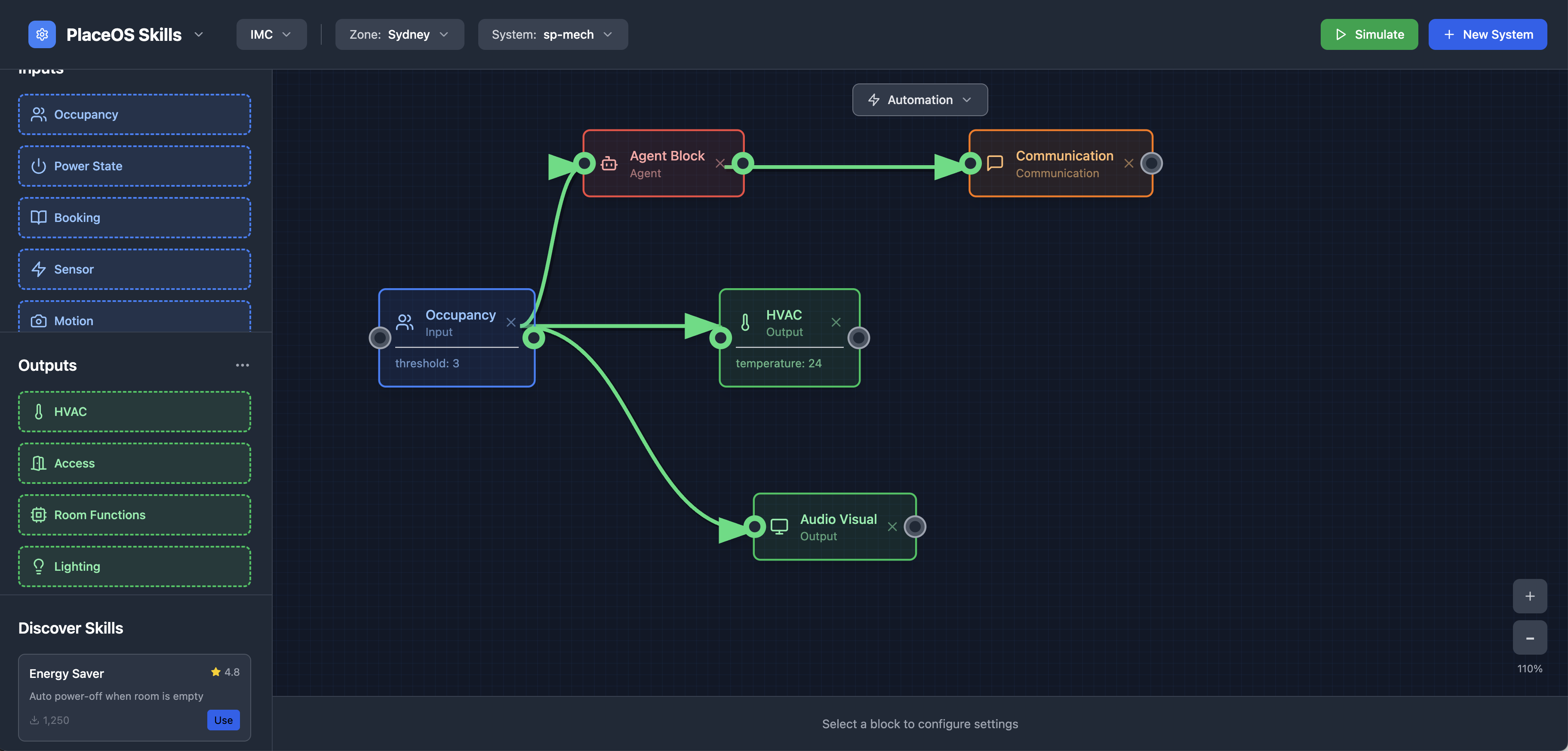
Interfaces are not hard-coded. They can be designed, deployed, and scaled independently of the backend systems. This enables rapid delivery and interface changes without reengineering core logic or automation. - Interface-Free Workflows
Not all solutions require a user-facing interface. For example, PlaceOS can automate workflows entirely in the background—ingesting data from one system and triggering actions in another. These workflows are configured once via the admin portal and then operate without user interaction. - Multiple Interfaces for Different Stakeholders
Tailor interfaces to different user groups—retail staff, managers, support teams, or facilities personnel. Each group can have a purpose-built interface aligned with their workflows and responsibilities. - Interfaces That Live Where Users Are
Because intelligence lives in the backend, PlaceOS interfaces can be delivered anywhere—via APIs. Whether it's a chat-based UI in Microsoft Teams, Slack, or Google Chat; embedded panels in Outlook or WebEx; or integrations with existing employee apps, we meet your users where they work. - Non-Disruptive to Existing Interfaces
PlaceOS integrates at the backend, meaning existing frontend interfaces don't need to change. This allows your current user experiences to remain intact, while PlaceOS extends functionality invisibly and non-disruptively.
Example: You can continue using Extron push-button AV controllers, while PlaceOS adds remote control functionality via QR codes, apps, or web portals—without interfering with Extron's operation. The same applies to HVAC, lighting, and other systems. - Data Streaming & Visualisation
PlaceOS can act as an MQTT broker and stream data to your existing analytics tools. Our platform also enables cross-referencing of internal and external data sources for deeper insights. We provide configurable dashboards but support full data portability.
Available Interfaces
These interfaces can be used out of the box or tailored to suit your specific requirements:
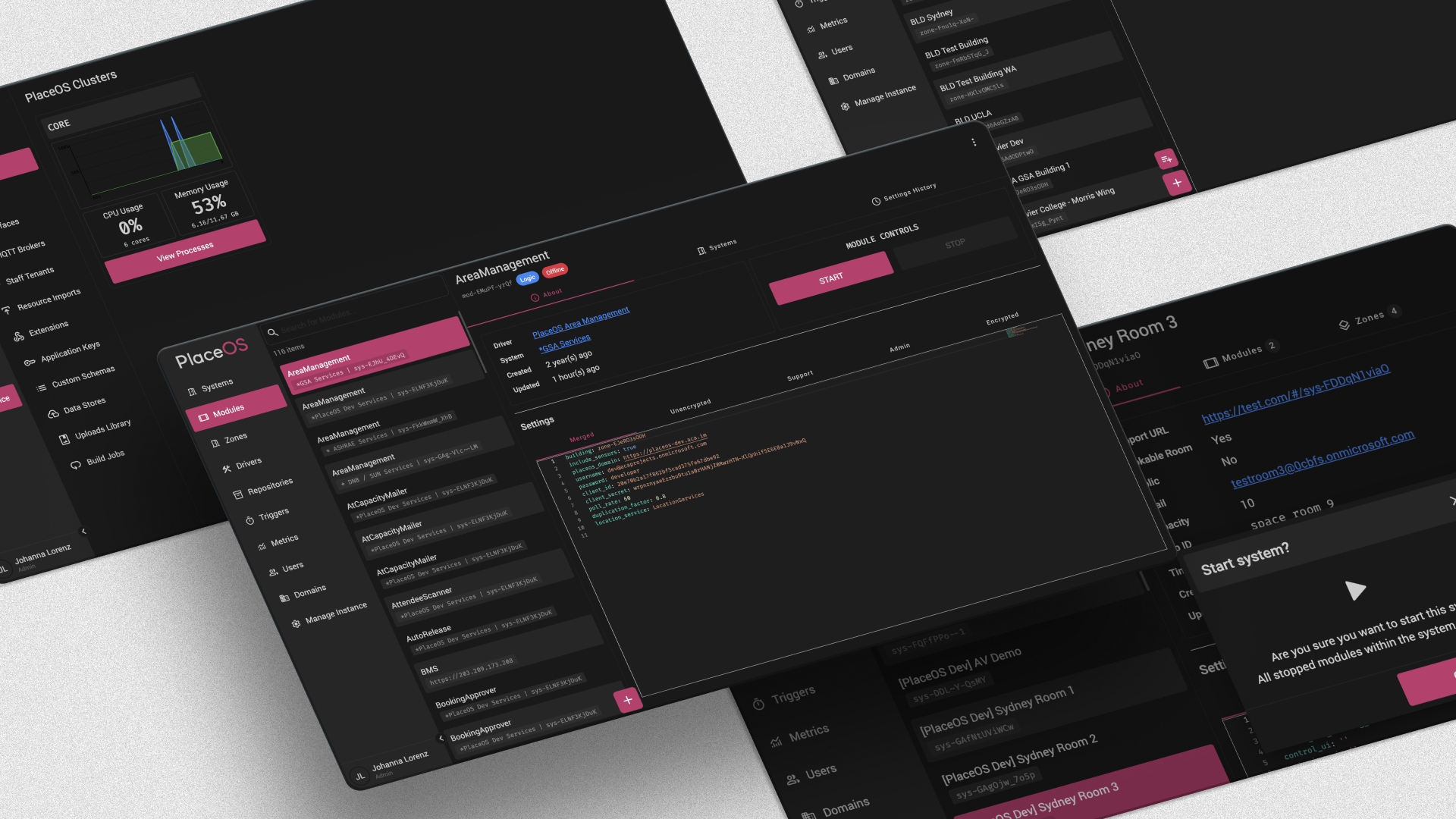
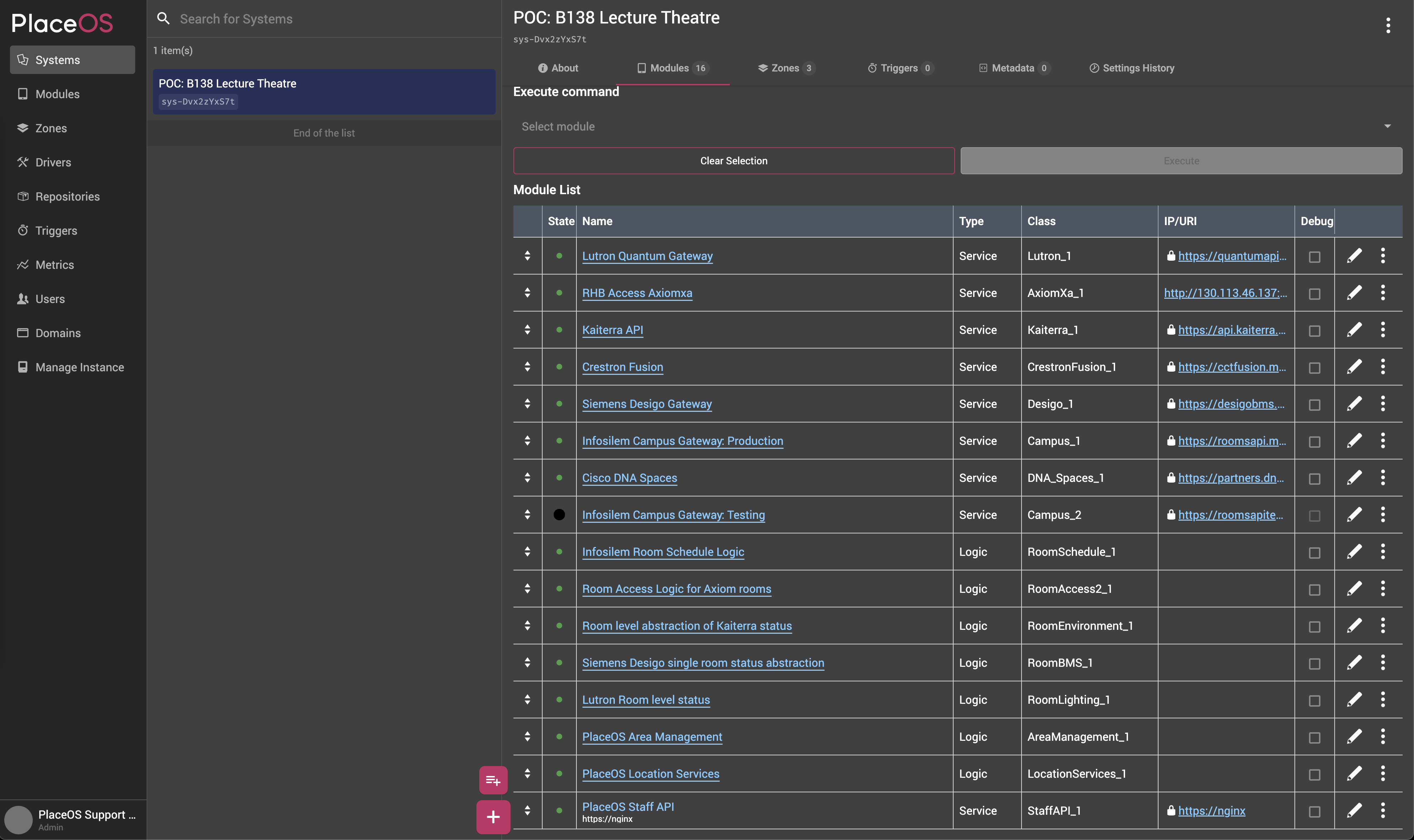
End User Interface
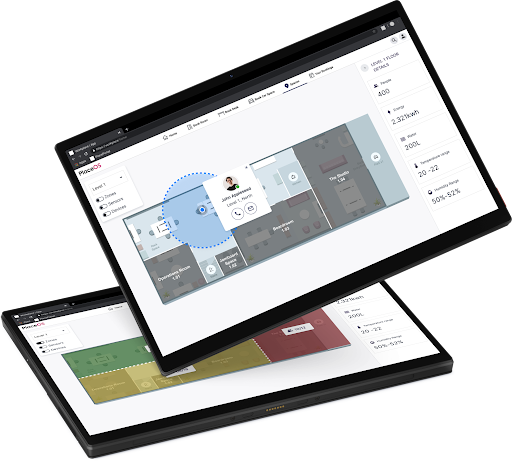
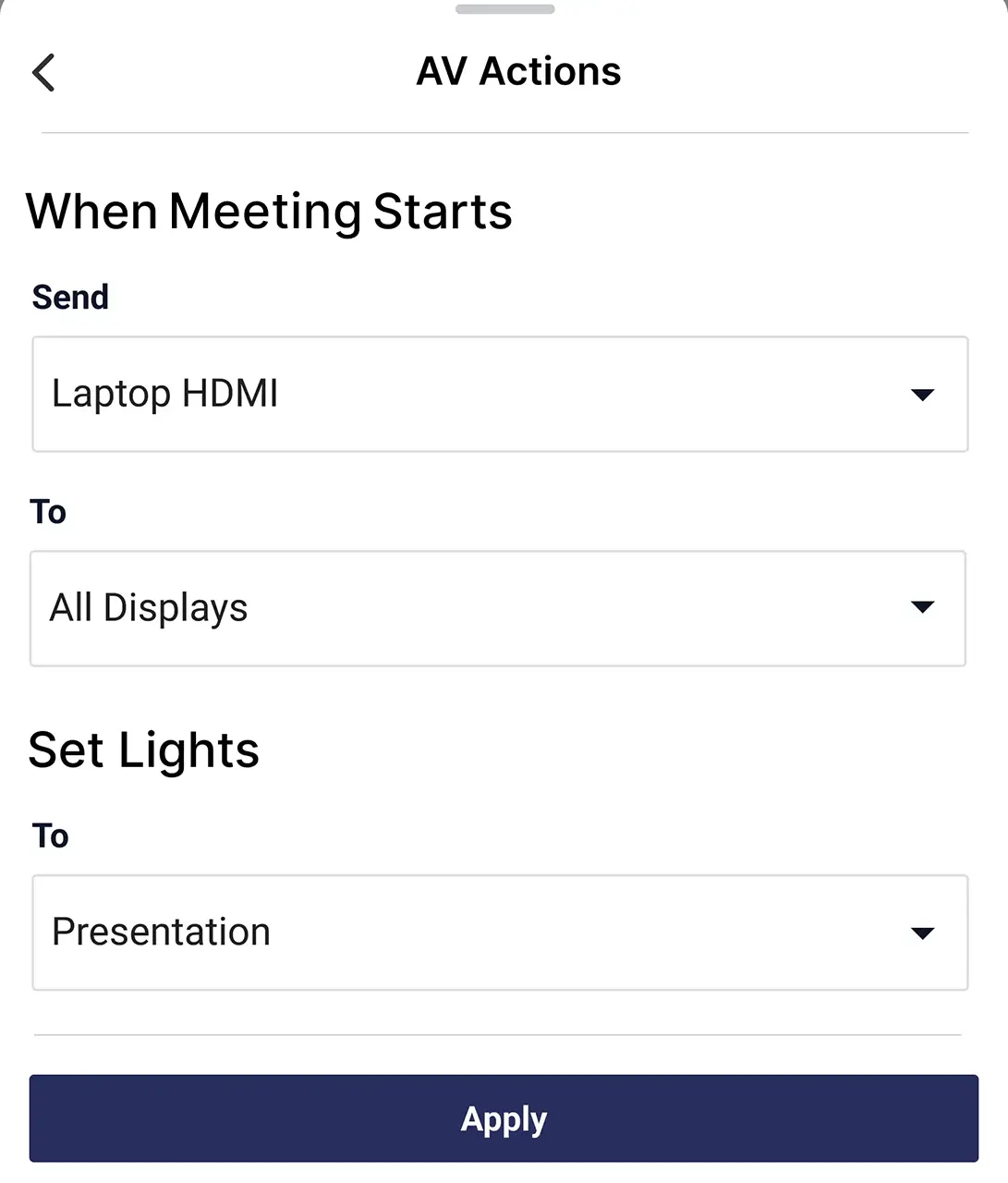
Designed for retail floor staff or store managers, this interface can include access to AV controls, environmental settings, scheduling, and more. Interactive floor plans are often included. Features can also be embedded directly into your existing employee apps via our APIs.
StageHand
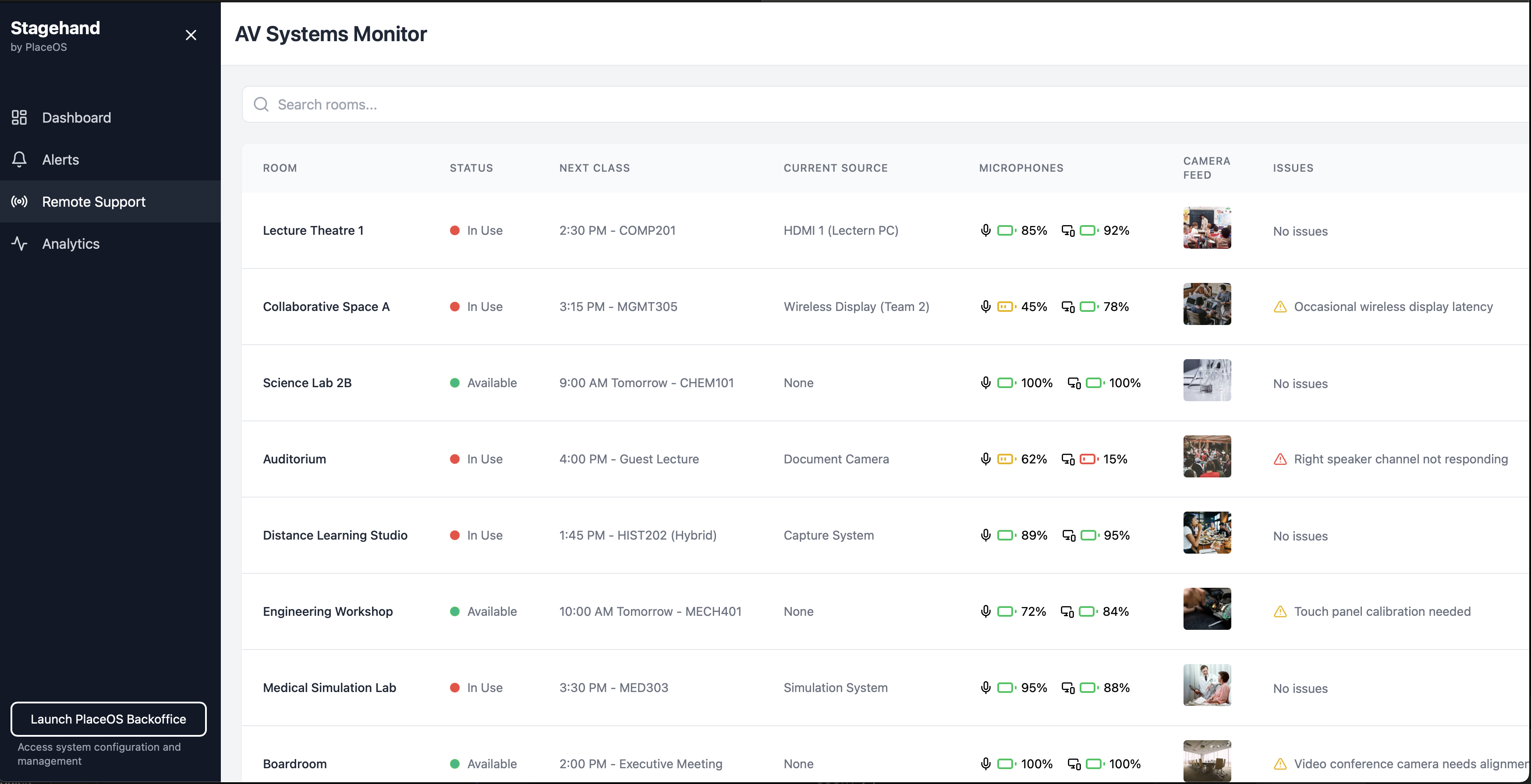
A remote management tool for facility teams and support staff. Unlike the technical Backoffice admin tool, StageHand is focused on quick access, control, and visibility of spaces for first-level support.
Backoffice
Designed for power users and administrators, Backoffice provides full control over automation logic, interface configuration, and system diagnostics. It includes advanced tools such as a device-level debug console—for example, viewing real-time error logs from an overheating display.
Data Visualisation
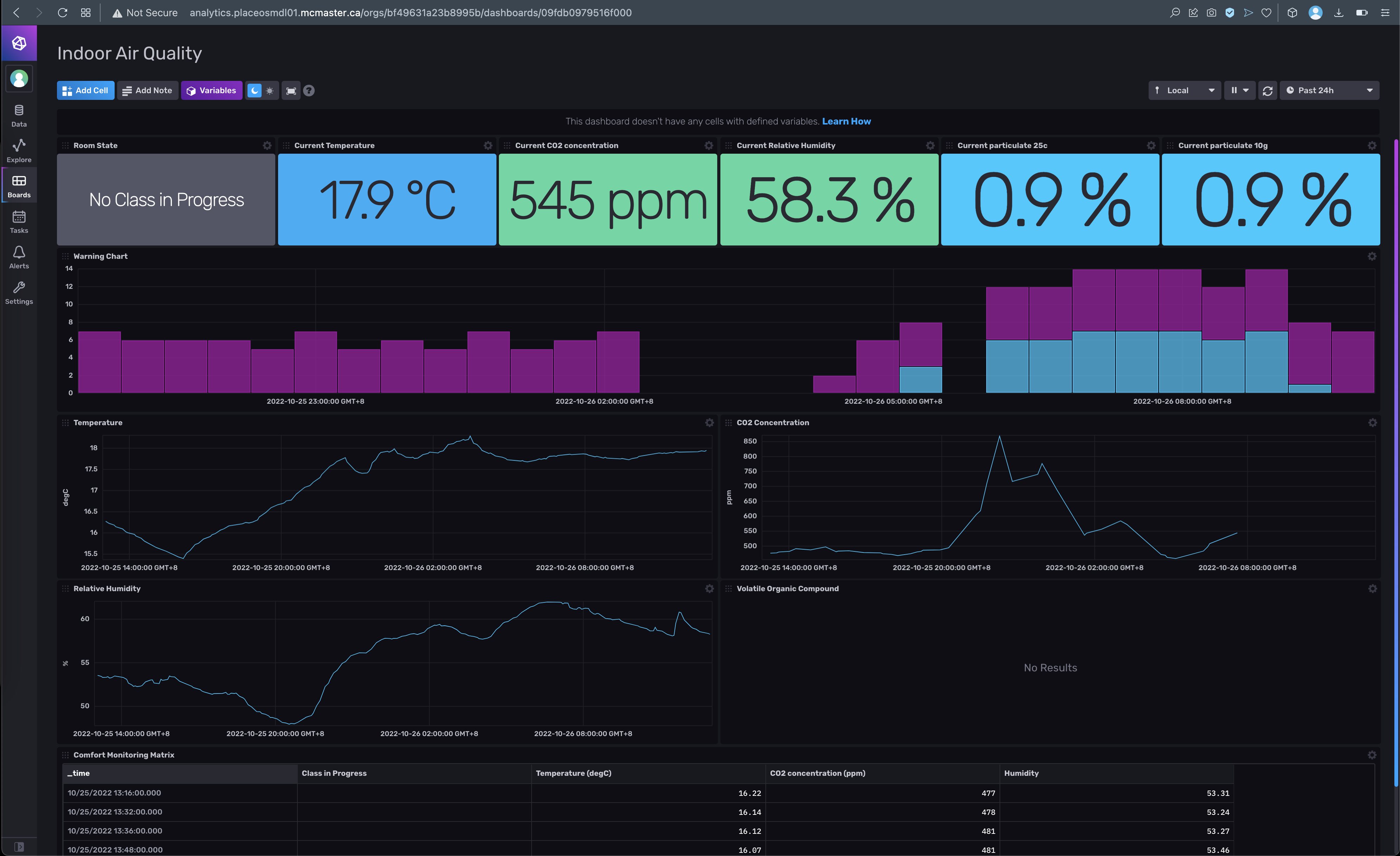
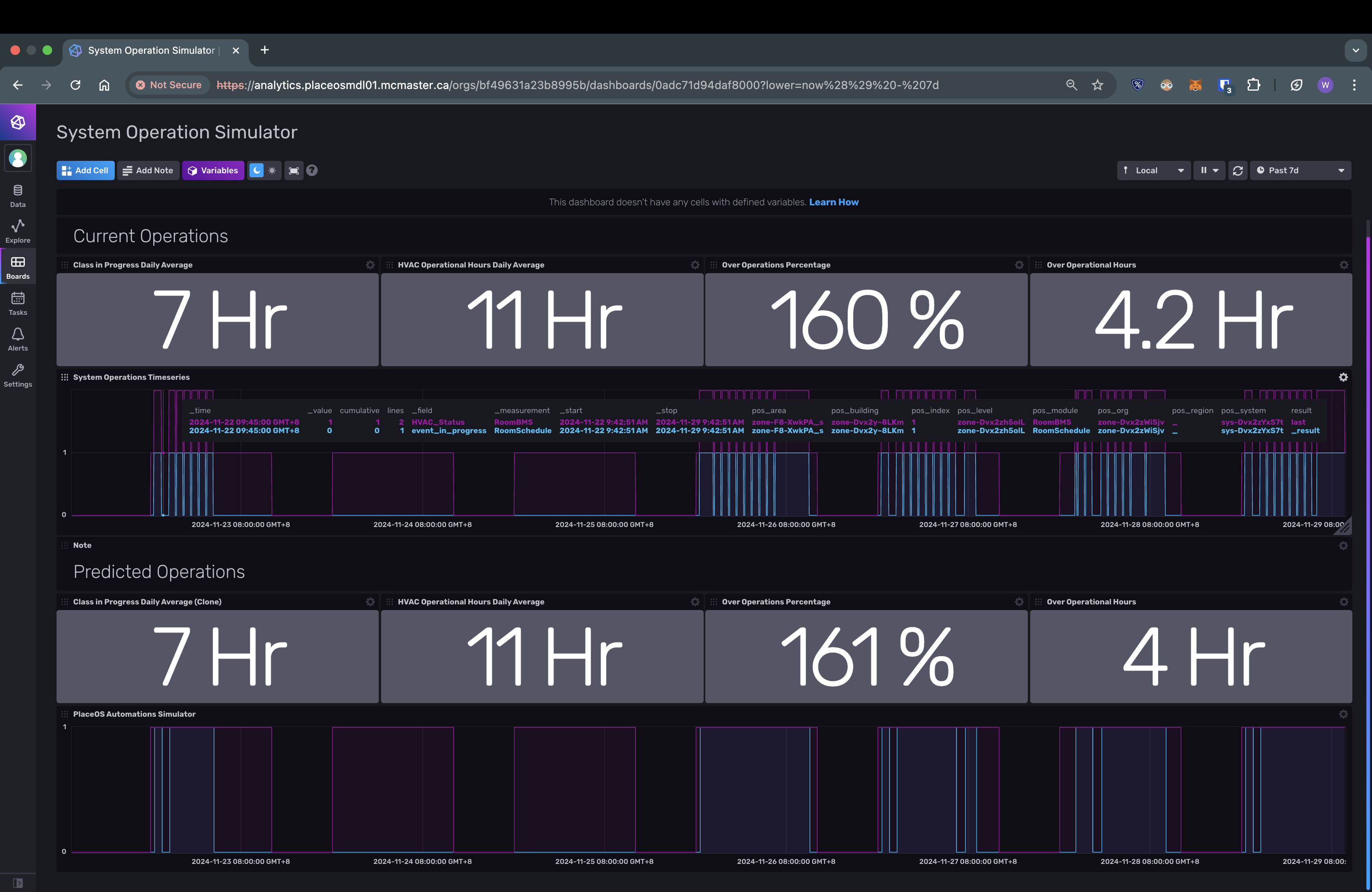
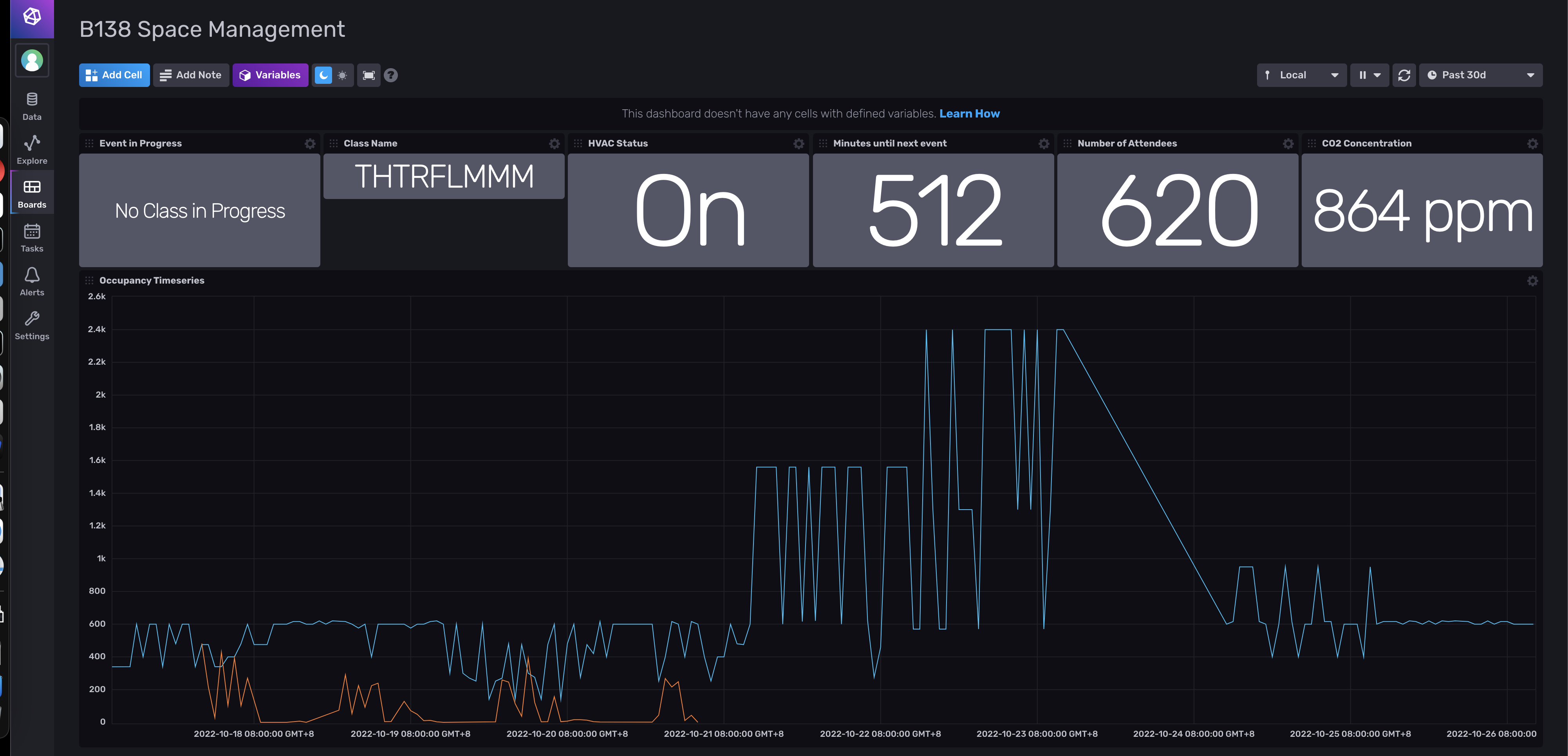
Our built-in time-series database captures and timestamps all relevant data, enabling highly configurable dashboards. Common use cases include:
- Real-time vs. scheduled resource usage (to identify inefficiencies)
- Occupancy vs. CO₂, temperature, and humidity levels (to improve air quality)
- AV and lighting usage analytics
- Power over Ethernet (PoE) consumption monitoring at the port level
Build your own
Our platform is built on open standards, allowing you to create your own interfaces and applications using our comprehensive developer tools.
Transforming the Apple Retail Environment
The implementation of PlaceOS will deliver tangible transformations to the in-store experience, the efficiency of daily operations, and the ability to manage the global retail portfolio with consistency and precision. The platform allows for the creation of a dynamic environment that responds intelligently to the needs of customers and staff.
Mockup
4.1 The In-Store Experience
Automated Store Opening and Closing
The daily bookends of retail operations can be transformed into a seamless, automated sequence. A single "Open Store" command, triggered by a schedule or a manager's action on a tablet, can initiate a coordinated symphony of events. The Lutron or Crestron lighting systems can fade up to a bright "Welcome" scene, the ALC HVAC system can adjust to its "Occupied" mode temperature setpoints, and the Extron-controlled digital signage and demonstration devices can power on. Simultaneously, access control systems can be set to daytime mode for public entry. At the end of the day, a "Close Store" sequence reverses this process, ensuring all non-essential systems are powered down, maximizing energy efficiency and guaranteeing security compliance across every location, every day.
Dynamic "Today at Apple" Sessions
The platform can enhance Apple's signature in-store events. When a "Today at Apple" session is booked in the scheduling system, PlaceOS can automatically prepare the designated event space. Fifteen minutes prior to the start time, the system can trigger a "Presentation" scene: the lights in the area dim appropriately, specific displays and audio systems activate to the correct inputs, and the HVAC system can even pre-condition the zone based on the number of expected attendees, ensuring optimal comfort. This level of automation frees up staff to focus on engaging with customers rather than managing building technology.
Responsive Customer Comfort
A premium customer experience requires a consistently comfortable environment. By leveraging data from existing infrastructure, such as Wi-Fi access points to generate real-time, anonymized occupancy estimates, PlaceOS can create a highly responsive environment. This occupancy data can be correlated with indoor environmental quality (IEQ) sensors that measure CO2, temperature, and humidity. If CO2 levels begin to rise in a particularly busy area of the store, indicating a need for more fresh air, the platform can automatically instruct the ALC BMS to increase the fresh air intake for that specific zone. This dynamic adjustment happens seamlessly in the background, maintaining a healthy and comfortable atmosphere during peak shopping times without requiring any manual intervention.
4.2 Empowering Store Operations
Simplified Staff Control
The complexity of managing multiple building systems is abstracted away from store staff. PlaceOS provides a simple, intuitive, and role-based interface, accessible on an iPad or other staff device. A store manager can have access to key controls for the entire store, while other staff members may have a more limited set of controls relevant only to their specific zone or task. This replaces the need for staff to be trained on several different, often complex, vendor-specific interfaces, simplifying operations and reducing the potential for error.
Proactive, Automated Facilities Management
The integration with Service Channel transforms facilities management from a reactive to a proactive discipline. Instead of waiting for a piece of equipment to fail and a store employee to report it, the system can identify anomalies and act on them automatically. An alert from an HVAC unit indicating abnormal pressure or an alert from a lighting panel showing a recurring fault can automatically trigger a detailed work order in Service Channel. This closed-loop system reduces equipment downtime, lowers administrative costs, and provides a comprehensive, auditable record of asset performance against maintenance activity and spend.
Meeting Corporate Sustainability Goals
PlaceOS provides powerful tools to help Apple achieve and exceed its corporate sustainability targets. The automated energy management logic, refined in numerous large-scale deployments, ensures that lighting and HVAC systems are only fully active in occupied zones and are set back to energy-saving modes when spaces are empty. The platform will continuously gather granular energy usage data from integrated systems, providing clear, verifiable reports on consumption, cost, and carbon savings. This data is essential for corporate sustainability reporting and for identifying further opportunities for efficiency improvements.
4.3 Centralized Management and Global Consistency
A Single Source of Truth
For regional facilities managers and for the broader APAC and global leadership teams, PlaceOS provides a unified, real-time dashboard to view the operational status of every store in the portfolio. This allows for powerful performance benchmarking, enabling teams to compare energy usage, asset reliability, and environmental conditions across different locations. It helps in the rapid identification of systemic issues and provides a tool to verify that operational standards are being met consistently.
Enforcing Brand and Operational Standards
Global brand and retail operations teams gain the ability to define and deploy standardized automation templates and environmental settings to all stores from a central location. This ensures that the customer experience—from the quality of the lighting to the ambient temperature—is consistent and meets Apple's high standards, whether a customer is in a store in Sydney, Singapore, or San Francisco. Updates to these standards can be pushed out centrally and instantly, eliminating the need for costly and time-consuming store-by-store manual configuration.
Data-Driven Insights for Operational Excellence
A core component of the PlaceOS value proposition is its ability to transform previously siloed and inaccessible data into actionable business intelligence. This section provides conceptual models of how the platform delivers insights tailored to different stakeholders within the Apple organization. The PlaceOS platform aggregates all data from hundreds of potential integration drivers into a centralized time-series database, which is the ideal foundation for the powerful reporting, trend analysis, and workflow automation that follows.
Occupancy + Automation: Low hanging fruit.
5.1 Key Performance Indicators for Retail Facilities
The platform will be configured to track and visualize Key Performance Indicators (KPIs) that are most relevant to managing a portfolio of premium retail environments. These metrics move beyond simple energy bills to provide a nuanced understanding of store performance.
Energy and Sustainability:
- Energy Use Intensity (EUI): A normalized metric that allows for accurate energy performance comparisons between stores of different sizes and in different climates.
- Energy Consumption per Visitor: A powerful KPI that links energy use directly to business activity, helping to understand the true cost of operations.
- Carbon Footprint per Store: Automated calculation of carbon emissions based on real-time energy consumption and local grid carbon intensity factors.
Operational Efficiency:
- Asset Uptime and Mean Time Between Failure (MTBF): Live tracking of critical assets (e.g., HVAC units, lighting panels) to measure reliability and inform capital planning.
- Automated vs. Manual Work Orders: A metric, derived from the Service Channel integration, that demonstrates the efficiency gains and administrative savings from automated fault detection.
Customer Experience and Environment:
- Environmental Consistency Score: A composite score that measures how consistently each store maintains key environmental parameters (e.g., temperature, CO2, humidity) within Apple's predefined optimal ranges.
- Zone Utilization vs. Environmental Conditions: Analysis of dwell time in specific store zones correlated with lighting levels and temperature to understand how the physical environment impacts customer behavior.
5.2 Example Analytics Dashboards
The following are conceptual designs for three distinct dashboards, each tailored to the needs of a specific user group within Apple. These are inspired by best practices in IoT and workplace analytics dashboard design.
Dashboard 1: Global/APAC Portfolio View (For Executive Leadership)
- Purpose: To provide senior leadership with a high-level, at-a-glance overview of the health, performance, and risk profile of the entire retail portfolio. The focus is on strategic KPIs and exception-based reporting.
- Visuals: The primary interface would be an interactive world map, with each store represented by a color-coded status icon (e.g., green for nominal, yellow for a minor non-critical alert, red for a critical alert requiring attention). Surrounding the map would be large, clear widgets displaying portfolio-wide KPIs: Total Energy Consumption (vs. Target), Aggregate Asset Uptime (%), Average Customer Comfort Score, and a summary of critical open work orders.
- Functionality: This dashboard is designed for drill-down analysis. Clicking on a continent or region (e.g., APAC) would filter all KPIs to that specific area. Hovering over a store icon would provide a snapshot of its key metrics. A click on a specific store would seamlessly transition the user to the detailed Store Manager Dashboard for that location. This design prioritizes a clean, holistic view for quick assessment.
Dashboard 2: Store Manager Dashboard (For In-Store Operations)
- Purpose: An operational tool designed for daily use by store managers and team leaders. It focuses on the immediate store environment, real-time conditions, and upcoming scheduled activities.
- Visuals: The central element would be a simplified, interactive floor plan of the store. This map would display real-time occupancy hotspots using a heatmap visualization, allowing managers to see which areas are busiest. Any active system alerts (e.g., "HVAC Zone 3 Temperature High," "Rear Entrance Door Ajar") would be clearly flagged on the map. Key widgets would show today's cumulative energy usage, a timeline of upcoming automated events (e.g., "Today at Apple - 2 PM: Presentation Scene Active"), and a panel of quick-access controls for common manual overrides (e.g., "Activate Cleaning Mode," "Extend Hours").
- Functionality: This dashboard is designed for immediate action. Tapping an alert on the floor plan would provide more detail and one-click actions, such as acknowledging the alert or escalating it to facilities. The design is inspired by real-time retail IoT dashboards that focus on store layout, live status, and immediate operational control.
Dashboard 3: Facilities and Energy Management Dashboard (For Technical Teams)
- Purpose: A deep-dive analytical tool for the facilities and energy management team. This dashboard provides the granular historical data and diagnostic tools needed to analyze long-term trends, troubleshoot complex issues, and manage the asset lifecycle.
- Visuals: This dashboard would be composed of highly detailed, customizable charts and graphs. Users could view historical trends of energy consumption broken down by system (lighting, plug load, HVAC). They could overlay HVAC performance charts showing setpoint vs. actual temperature, fan speed, and runtime to diagnose inefficiencies. A filterable asset list, with live status and complete maintenance history pulled directly from the Service Channel integration, would be a core feature.
- Functionality: The emphasis here is on powerful data exploration and reporting. Users could select custom date ranges, compare performance across multiple stores, and export raw data in CSV or PDF formats for further analysis. This dashboard provides the evidence needed to justify system upgrades, modify operational strategies, and validate the ROI of efficiency projects. The data gathered here can also provide a crucial feedback loop to Apple's store design teams, offering quantitative insights into how different design choices impact energy performance and operational cost in the real world, thereby informing and optimizing the next generation of Apple's iconic retail spaces.
Proposed Path Forward: A Phased Partnership
A structured, multi-phase partnership is proposed to ensure a successful deployment that minimizes risk and is designed to demonstrate tangible value at each stage. This approach aligns with Apple's request to begin with a focused Proof of Concept for a single store and provides a clear, scalable path toward a global solution. This mirrors the successful engagement model PlaceOS has employed with other large, multi-site enterprise organizations.
6.1 Phase 1: Proof of Concept (Single Store)
Objective
The primary objective of Phase 1 is to deploy a production-ready PlaceOS instance for a single, mutually agreed-upon flagship Apple retail store. This POC is not a temporary trial; it is the foundational first step of the production rollout. It will involve the complete integration of the core building systems, the deployment of key automation workflows, and the validation of the data analytics dashboards in a live operational environment.
Timeline
The projected timeline for the completion of the Proof of Concept is 6 to 8 weeks from the official project kickoff.
Success Criteria
The success of the POC will be measured against the following clear, objective criteria:
- Successful integration and bi-directional control of the in-scope Extron (AV), Lutron/Crestron (lighting), and ALC (HVAC) systems.
- Successful deployment and daily operation of at least three key automation workflows (e.g., Automated Store Open/Close, Dynamic Customer Comfort, "Today at Apple" Scene Setting).
- Live, accurate data from all integrated systems populating the three conceptual dashboards (Portfolio, Store Manager, Facilities).
- Demonstrated bi-directional integration with Apple's Service Channel sandbox environment, including the successful automated creation of a test work order triggered by a platform-generated alert.
The following table provides a detailed breakdown of the scope and specific deliverables for this foundational phase.
| Workstream | Details | Deliverables |
|---|---|---|
| System Integration | HVAC: Integration with ALC BMS via BACnet/IP. | Real-time monitoring and control of temperature setpoints and modes visible in the PlaceOS interface. |
| Lighting: Integration with Lutron or Crestron system. | Live control of predefined lighting scenes (e.g., Welcome, Presentation, Closed) from the PlaceOS interface. | |
| Audiovisual: Integration with Extron control system. | Remote power on/off and source selection for designated displays and audio zones. | |
| Facilities Mgt: Integration with Service Channel API. | Connection to Service Channel sandbox; ability to create a test work order from a PlaceOS-generated event. | |
| Automation Services | Store Operations: Automated Open/Close sequence. | A fully automated workflow that adjusts lighting, HVAC, and AV based on the store's operating schedule. |
| Customer Comfort: Occupancy-based climate response. | An active rule that correlates Wi-Fi occupancy data with IEQ sensors to modulate HVAC settings in real-time. | |
| Data & Analytics | Dashboard Deployment: Setup of all three dashboards. | Live data from the POC store populating the Portfolio, Store Manager, and Facilities dashboards. |
| Reporting: Configuration of basic energy reports. | The ability to generate and export a weekly energy consumption report for the POC store. | |
| Interfaces | Admin & Staff Access: Configuration of user roles. | Provisioned access for key Apple stakeholders to the relevant dashboards and control interfaces. |
6.2 Phase 2 and 3: Regional and Global Rollout
Phase 2 (Regional Rollout)
Upon the successful completion and joint review of the POC, the project will move into the regional rollout phase. The integration templates, driver configurations, and automation logic established during the POC will be used as a standardized blueprint. This reusability dramatically accelerates the deployment timeline for subsequent stores. The initial focus will be on the remaining stores in the Australian portfolio, followed by a planned expansion across the broader APAC region under the guidance of regional leadership.
Phase 3 (Global Standardization)
The centralized, cloud-native architecture of the PlaceOS platform is ideally suited for global expansion. The proven solution from the APAC rollout can be efficiently scaled to the entire global retail fleet. This will provide Apple with a single, standardized smart building platform, ensuring operational consistency and a uniform brand experience worldwide. The PlaceOS global support structure is designed to scale in parallel with this deployment, ensuring high uptime and responsive support across all time zones.
Investment and Commercial Models
The proposed commercial model is designed for transparency, predictability, and scalability. The structure consists of two primary components: a recurring annual Platform License and one-time Professional Services fees for implementation. This model is consistent with the framework used in previous successful enterprise deployments.
7.1 Platform Licensing
The core of the commercial model is an annual, per-store subscription fee. This license provides comprehensive access to the PlaceOS platform, including all integrated drivers, automation logic engines, and user interfaces. It also includes standard technical support and all ongoing software updates, enhancements, and security patches. This model provides Apple with a predictable annual operational expenditure (OpEx) that scales linearly as the solution is expanded across the retail portfolio. The licensing is based on a fixed price per location and is not tied to the number of users, integrated devices, or API calls, offering an unlimited usage model that encourages full adoption and exploration of the platform's capabilities.
7.2 Professional Services
A one-time, fixed-fee Professional Services engagement is proposed for the delivery of the Phase 1 Proof of Concept. This fee covers all the necessary expert resources from the PlaceOS team to ensure a successful deployment, including project management, solution architecture, discovery and technical scoping workshops, integration driver configuration, custom logic development for automation workflows, and the complete setup and validation of the analytics dashboards.
The following table provides a clear, itemized breakdown of the investment for both the initial POC and the subsequent per-store rollout model.
PoC Quote
| Item | Description | Cost (USD) |
|---|---|---|
| Part 1: Phase 1 - Proof of Concept (1 Store) | ||
| PlaceOS Annual Platform License | Annual subscription for one (1) retail store location. Includes support and updates. | no license cost for PoC |
| Professional Services (POC) | One-time fee for discovery, integration, configuration, and dashboard setup for the initial store. | $85,000 |
| Total POC Investment | One-time service fee. | $85,000 |
Global rollout price guide.
| Tier | Range | License(yearly) | Services (once-off) | Subtotal | |
|---|---|---|---|---|---|
| Tier 1 | 1–50 | $3,000 | $2,000 | 50 | $250,000 |
| Tier 2 | 51–200 | $2,250 | $1,200 | 150 | $517,500 |
| Tier 3 | 201–539 | $1,500 | $900 | 338 | $812,400 |
| Rollout Totals | |
|---|---|
| Component | Cost |
| POC (Professional Services) | $85,000 |
| Tier 1 Rollout (50 stores) | $250,000 |
| Tier 2 Rollout (150 stores) | $517,500 |
| Tier 3 Rollout (338 stores) | $812,400 |
| Total Rollout Investment (Year 1) | $1,664,900 |
| Year 2+ Ongoing license subscriptions only | $994,500 |
Discount Summary
- Moving from Tier 1 → Tier 2 saves $750 per store, or 25%.
- Moving from Tier 2 → Tier 3 saves another $750 per store, or 33%.
- Overall, by the time Apple reaches Tier 3 scale, they're paying half the per-store rate compared to the first 50 stores.
- Year 2+ has no setup fees (40% lower fee to year 1)
Additional discounts available.
- Pre-Purchase Incentive – Discounts available for pre-purchasing store licenses in bulk, enabling Apple to fast-track deployment at scale and lock in lower rates across the initial rollout.
- Multi-Year Commitment – Discounted annual license fees for 3- or 5-year agreements, providing predictable cost and locked-in pricing.
- Case Study Partnership – Further reductions available where Apple agrees to participate in a joint case study showcasing innovation and measurable outcomes achieved through PlaceOS.